
- About Us
- Solutions
-
Products
Products
- Applications
-
News
News
-
Contact Us
Contact Us

Check out fresh news of Alphacell International.
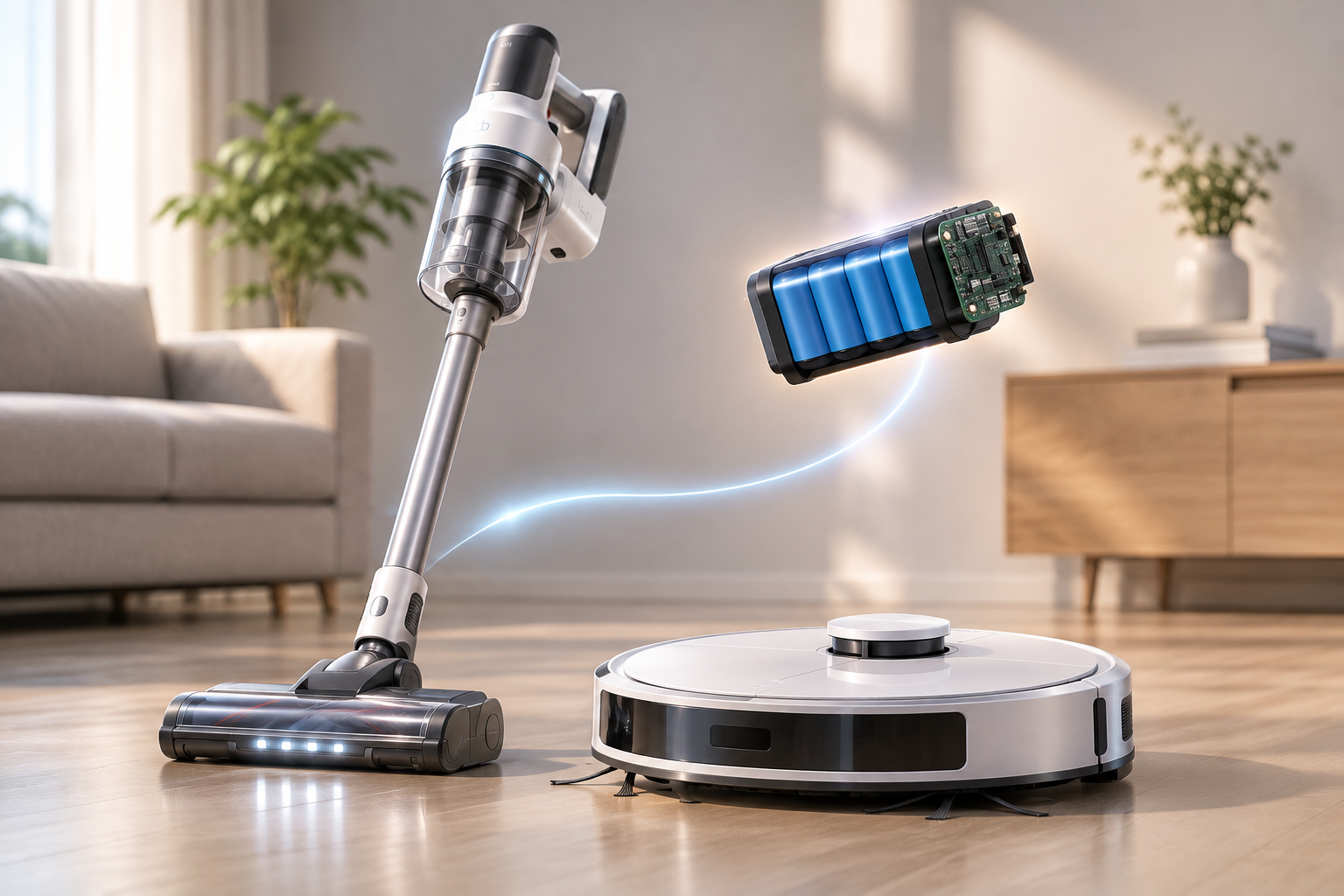
Household cleaning appliances have rapidly shifted from corded to cordless models and
robot vacuums that clean autonomously have also become increasingly common.
Although both types are designed for cleaning, cordless stick vacuums and
robot vacuums have different battery requirements due to their distinct operating methods and usage environments.
AlphaCell International supports battery pack development for household cleaning appliances from the initial review stage,
considering product requirements and operating conditions to evaluate cell selection,
battery pack configuration, protection circuits, and charging conditions.
In this article, we explore the key differences between cordless stick vacuums and
robot vacuums, along with important battery selection criteria and design considerations throughout the development process.
1. Cordless Stick Vacuums: Strong Suction Power and Lightweight Design
Cordless handheld and stick vacuums use high-speed motors to generate strong suction power.
In particular, maximum-power modes require high discharge current from the battery.
At the same time, since users carry and operate these products directly, battery weight and size are also important.
In addition to output and runtime, the overall product weight and center of gravity must be considered.
During the initial development stage, the following requirements are reviewed:
- Discharge current required in maximum suction mode
- Power consumption and target runtime in standard and high-power modes
- Available battery pack dimensions and weight
- Replaceable battery configuration and mounting structure
- Charging method and charging time
Because power consumption varies significantly depending on the suction mode,
cell discharge performance and battery pack capacity must be evaluated based on actual usage patterns for each operating mode.
2. Robot Vacuums: Operating Time and Repeated Charging Conditions
Robot vacuums operate multiple components simultaneously, including suction motors, drive motors, and brushes.
Therefore, battery capacity and output must be designed with consideration for the cleaning area,
operating time, and driving and suction conditions.
Robot vacuums also return to their charging docks after cleaning resulting in repeated charging and discharging cycles.
For this reason, factors such as cycle life, charging conditions, temperature management and
protection functions are just as important as cell capacity.
During the initial review, the following factors should be considered:
- Target cleaning area and operating time
- Power consumption under different suction and driving conditions
- Cell cycle-life characteristics under repeated charge and discharge
- Protection functions suitable for automatic charging environments
- Battery pack dimensions compatible with the product's internal structure and height
- Charging current and temperature management during charging
Since users do not usually manage the charging process directly, the cells, protection circuits, and
charging conditions must be evaluated together to ensure stable operation in an automatic charging environment.
3. Battery Pack Development: From Initial Review to Production Preparation
Cordless stick vacuums and robot vacuums have different product structures and usage patterns.
Therefore, the characteristics of the target product must be clearly understood from the earliest stages of battery pack development.
① Initial Requirements and Usage Environment Analysis
At the beginning of development, the product's intended use and operating conditions are reviewed.
- Product type and primary operating method
- Target voltage and required capacity
- Normal operating current and maximum load current
- Target runtime and charging time
- Battery pack installation space and dimensional requirements
For cordless stick vacuums, AlphaCell reviews power consumption and usage ratios for each suction mode.
For robot vacuums, the cleaning area and driving and suction conditions are used as the basis for defining requirements.
Since the starting points differ by product type, the initial review items also vary.
② Cell Selection and Battery Pack Configuration
Candidate cells are evaluated based on capacity, discharge performance, internal resistance, and cycle life.
The series configuration is reviewed to meet the target voltage,
while the parallel configuration is determined according to the required capacity.
Battery pack dimensions and weight must also be considered in relation to the available space inside the product.
Rather than selecting a cell based on a single specification,
AlphaCell compares two to three candidate cells in terms of performance, dimensions, and supply conditions.
Since the internal space of cleaning appliances is often limited,
even a difference of a few millimeters in cell dimensions can affect the overall battery pack layout.
③ Protection Circuit and Charging Condition Review
For stable battery pack operation, the key functions of the BMS and protection circuits must be reviewed.
Protection against overcharge, over-discharge, overcurrent, short circuits, and
abnormal temperature increases must be suitable for the product's actual operating conditions.
Charging conditions are also evaluated based on the cell's allowable charging voltage and current,
as well as temperature increases during charging.
For products such as robot vacuums that undergo repeated automatic charging,
the charging environment and usage cycle must be considered together.
④ Certification and Safety Requirements
Since these products are used in household environments,
applicable safety requirements should be reviewed from the early development stage.
For products distributed in Korea, the applicability of KC safety requirements and
relevant test items should be checked separately for the battery pack and the finished product.
UN 38.3 testing requirements for lithium battery transportation should also be reviewed.
⑤ Production Preparation and Quality Review
Before moving into production, the battery pack assembly structure,
cell fixation, insulation and wiring layout, and connection stability should be checked.
It is important to verify whether the selected cell arrangement
can be maintained reliably during actual assembly within the product's limited internal space.
Key inspection items and production conditions should also be established.
Preparing consistent assembly and inspection standards helps ensure
that the performance verified during the prototype stage can be maintained throughout production.
4. Common Challenges in the Development Process
The challenges encountered during vacuum cleaner battery pack
development vary depending on the product's usage patterns and internal structure.
Actual Runtime Falling Short of Expectations
The runtime calculated from a cell's rated capacity often differs from the actual operating time of the finished product.
For cordless stick vacuums, even a slight increase in the use of
high-power mode can significantly reduce runtime. For robot vacuums,
power consumption increases in environments with higher driving resistance, such as carpets and thresholds.
Therefore, battery capacity should be determined based on power
consumption under different operating modes and usage environments to achieve more realistic runtime expectations.
Battery Life Under Repeated Charging Conditions
Robot vacuums repeatedly charge and discharge during normal use,
often without users actively monitoring the process. Over time, this can lead to complaints about reduced cleaning time.
It is therefore important to consider not only the cell's cycle life
but also the charging voltage setting and how the battery is managed while the robot vacuum remains on its charging dock.
These factors play an important role in maintaining battery life.
Battery Pack Configuration Within Limited Space
In many cleaning appliances, the product's external design is determined before the battery pack is integrated.
In cordless stick vacuums, battery placement directly affects the center of gravity and
the strain placed on the user's wrist. In robot vacuums, height restrictions can limit the available cell arrangement options.
Several layout options must be compared while considering available space, weight, and capacity together.
Reviewing these challenges alongside the product's operating
environment and structural requirements from the early development stage can help reduce design changes and repeated testing.
Conclusion
Battery requirements vary depending on the type of cleaning appliance.
Cordless stick vacuums prioritize output performance and
weight, while robot vacuums require careful consideration of runtime and reliability under repeated charging conditions.
AlphaCell International supports the overall battery pack development process,
from initial requirements review and cell selection to battery pack configuration, protection circuit and
charging condition evaluation, safety requirement reviews, and production preparation.
If you are considering battery pack development for a cleaning appliance, suitable cells and
battery pack configurations can be evaluated based on product type, target runtime, required voltage, and available installation space.
Please feel free to contact us via Contact Us or support@alphacell.co.kr
#CordlessVacuum #RobotVacuum #HomeApplianceBattery #BatteryPack#LithiumIonBattery #BatteryDevelopment #KCCertification #UN38.3#AlphaCellInternational


 Google map


