
- About Us
- Solutions
-
Products
Products
- Applications
-
News
News
-
Contact Us
Contact Us

Check out fresh news of Alphacell International.
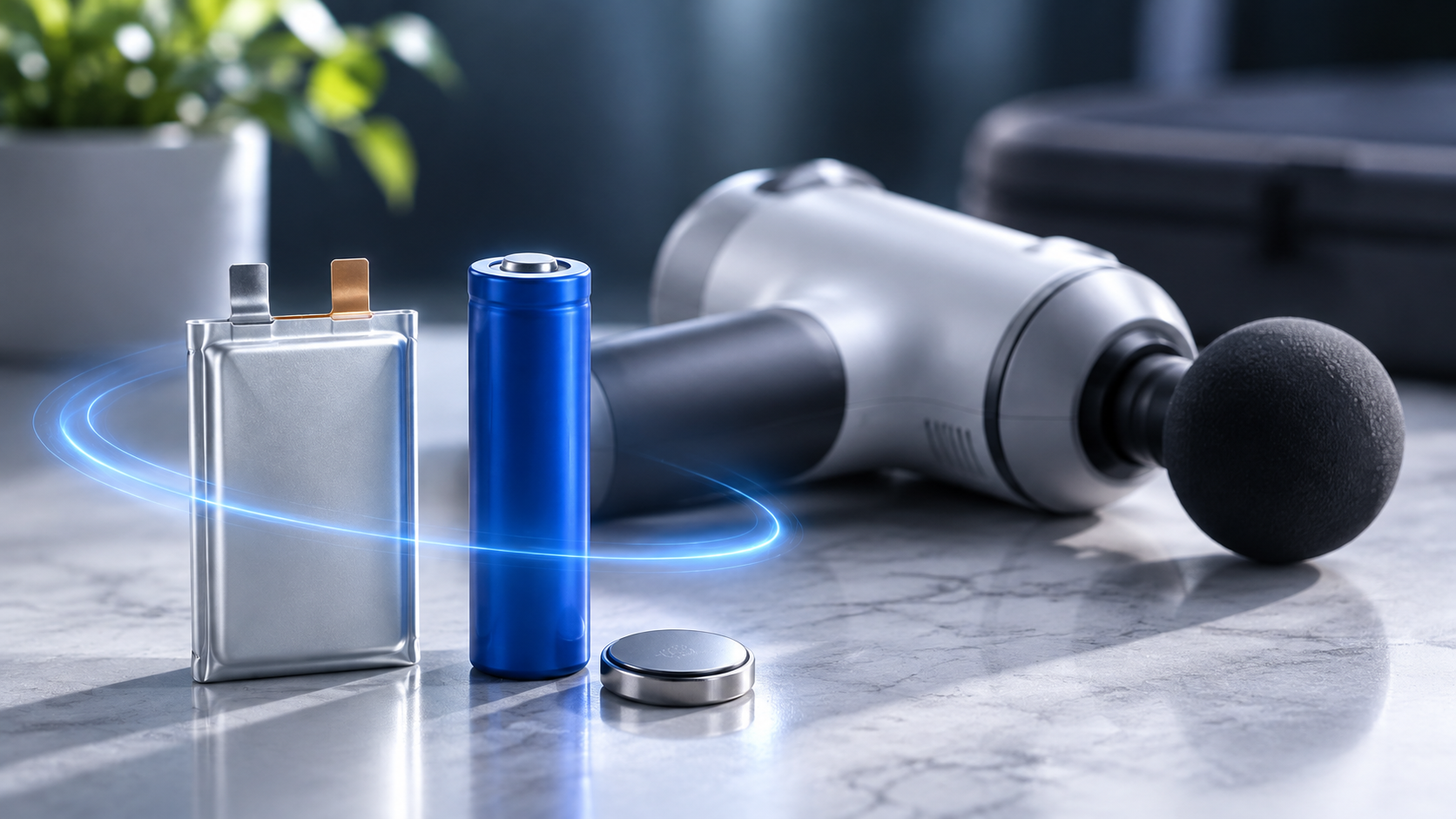
As the market for personal healthcare and beauty devices continues to expand,
products such as massage guns, RF beauty devices, LED masks, and portable skincare devices are becoming increasingly common.
This has also increased the importance of battery pack design in these applications.
Since these products are typically handheld or used in direct contact with the skin,
battery size and weight must be considered alongside power output, heat generation, and safety.
AlphaCell International reviews battery pack requirements for compact healthcare and beauty devices,
considering product usage and internal structure when evaluating cell selection,
battery pack configuration, protection circuits, and charging conditions.
In this article, we introduce the key characteristics of batteries used in massage guns, beauty devices, auxiliary power systems,
and backup applications, along with important design considerations throughout the battery pack development process.
1. Massage Guns: High Power Output in a Compact Structure
Massage guns use internal motors to move the massage head back and forth at high speeds,
delivering vibration and percussion to muscles.
As the intensity increases or greater pressure is applied to the massage head, motor load increases,
resulting in higher instantaneous discharge current requirements from the battery.
At the same time, batteries are often installed inside the handle, which places restrictions on cell size and arrangement.
During battery pack development, the following factors are reviewed:
- Discharge current requirements for each operating intensity mode
- Peak current requirements according to motor load
- Cell type and arrangement suitable for the internal handle space
- Battery and motor heat generation during continuous operation
- Cell fixation and insulation structures designed to withstand vibration and external impact
- Target operating time and charging time
Massage guns require careful consideration of both instantaneous power demand and heat generation during extended operation.
Rather than selecting a battery based solely on rated capacity,
cell discharge performance, internal resistance, and actual operating conditions should be evaluated together.
2. Beauty Devices: Slim and Lightweight Design with Temperature Management
RF, LED, and low-frequency beauty devices, as well as portable skincare devices,
generally place greater emphasis on product thickness, weight, operating time, and stable power supply rather than high instantaneous output.
Depending on the internal space and external design, compact pouch cells or cylindrical cells can be considered for these applications.
Key battery pack design considerations include:
- Cell dimensions suitable for product thickness and design
- Target operating time and battery capacity
- Temperature rise during charging and operation
- Thermal management between the battery and skin-contact areas
- Charging circuit configuration according to input methods, such as USB charging
- Protection functions against overcharge, over-discharge, and abnormal temperatures
For products that come into direct contact with the skin,
heat generated by the battery and internal circuits can affect the product's surface temperature.
Therefore, it is important to evaluate not only the cell's heat generation characteristics but also its internal placement and heat transfer structure within the product.
3. Auxiliary Power and Backup Batteries: Maintaining Long-Term Power Availability
Some compact healthcare devices, medical equipment,
and electronic products use auxiliary power sources or backup batteries in addition to their main power supply.
Depending on the intended application, backup batteries may be used to retain internal clock settings and configuration data when the main power is disconnected,
or to support continued device operation for a certain period in the event of a main power failure.
Unlike conventional operating batteries, these batteries often need to maintain their functionality over extended standby periods.
During development, the following factors are reviewed:
- Purpose of the backup power source and required backup duration
- Self-discharge characteristics and remaining capacity during extended standby
- Power switching methods between the main and backup power sources
- Power consumption in standby mode
- Long-term storage and charging conditions
- Cell dimensions and configuration suitable for the product's internal space
In particular, memory backup batteries and emergency operating batteries have different capacity and output requirements.
Therefore, the target backup circuit and expected operating time must first be identified before selecting suitable cells and protection circuit configurations.
4. Battery Pack Development: From Initial Review to Production Preparation
Battery packs for compact healthcare and beauty devices are developed through several stages, taking into account the product's external design,
internal structure, and operating environment.
① Initial Requirements and Operating Environment Analysis
During the initial development stage, battery requirements are defined based on the product's main functions and intended usage.
- Product type and primary operating method
- Target voltage and required capacity
- Normal operating current and maximum load current
- Target operating time and charging time
- Battery installation space and dimensional requirements
- Operating environment and expected temperature range
For massage guns, motor load and instantaneous discharge current are key considerations.
For beauty devices, product thickness, operating time, and surface temperature are given greater attention.
For products requiring backup power, the intended backup function and required standby duration are reviewed separately.
② Cell Selection and Battery Pack Configuration
Candidate cells are compared based on capacity, discharge performance, internal resistance, dimensions, weight, and supply conditions.
The series configuration is reviewed according to the target voltage,
while the parallel configuration is determined based on the required capacity and discharge performance.
Cylindrical and pouch cells are also evaluated according to their structural characteristics and suitability for the available internal space.
Even cells with the same rated capacity can differ in dimensions and shape, affecting battery pack layout and the product's internal design.
For this reason, it is beneficial to review cell selection and structural design together from the early product design stage.
③ Protection Circuit and Charging Condition Review
To ensure stable battery operation, protection functions against overcharge, over-discharge, overcurrent, short circuits, and abnormal temperatures are reviewed.
The charging circuit is designed according to the cell's allowable charging voltage and current.
For products using various input methods, such as USB charging, charging stability under different input power conditions must also be evaluated.
In addition, temperature sensing locations and protection settings are reviewed according to the product's operating environment and internal structure.
④ Certification and Safety Requirements
Healthcare and beauty devices may be subject to different certification and safety requirements depending on their intended use and product classification.
For products distributed in Korea, applicable KC requirements for the battery pack and finished product should be identified separately.
UN 38.3 testing requirements for lithium battery transportation should also be reviewed according to the product's supply and transportation plans.
⑤ Production Preparation and Quality Review
Before mass production, the battery pack assembly structure, cell fixation, insulation, wiring layout, and connection stability are reviewed.
In particular, compact battery packs contain densely arranged components within limited spaces,
making detailed assembly conditions such as tab welding, insulation, and cell protection structures especially important.
Key inspection items and assembly conditions should be established to maintain the quality standards verified during the prototype stage throughout mass production.
5. Key Considerations During the Development Process
Battery pack development for compact healthcare devices involves various technical considerations depending on product size and usage patterns.
Heat Management During High-Intensity Operation
When massage guns operate at high intensity for extended periods,
heat generated by the battery and motor can accumulate inside the product.
In addition to individual cell performance, battery and motor placement, heat transfer paths,
and temperature protection conditions must be considered together.
Selecting Cell Dimensions Suitable for Product Design
For slim beauty devices, finding cells that fit the product's design is particularly important.
Standard cells generally offer advantages in terms of availability and production schedules,
but their dimensions may not perfectly match the product design.
Custom-sized pouch cells can provide better space utilization,
but minimum order quantities and supply lead times must also be considered.
Therefore, product design, capacity, supply conditions, and development schedules should be evaluated together.
Temperature Management When Using Devices Immediately After Charging
Products that come into contact with the skin are sometimes used immediately after charging.
Charging current and temperature protection conditions should be configured according to the product's characteristics
to prevent heat generated during charging from affecting the device's temperature when operation begins.
Long-Term Reliability of Backup Batteries
Although backup batteries may be used infrequently under normal conditions, they must operate properly when needed.
In addition to initial capacity, self-discharge characteristics, storage conditions,
and expected service life should be considered when selecting suitable cells and power management configurations.
Conclusion
Although massage guns, beauty devices, and compact healthcare products are relatively small, their battery requirements vary depending on their intended applications.
Output, capacity, weight, heat generation, and safety must all be considered during battery pack development.
Auxiliary power systems and backup batteries also require different design considerations from conventional operating batteries,
particularly in terms of standby life and power retention.
AlphaCell International supports the overall battery pack development process,
from initial specification review and cell selection to battery pack configuration, protection circuits, charging conditions, safety requirement reviews, and production preparation,
based on each product's operating environment and structural requirements.
If you are considering battery pack development, please share information such as product dimensions, required power output, target operating time,
and available installation space. We will be happy to review suitable cells and battery pack configurations for your application.
Please feel free to contact us via Contact Us or at support@alphacell.co.kr.
Thank you.
#MassageGunBattery #BeautyDeviceBattery #PouchCell #HealthcareDevice #BackupBattery #AuxiliaryPower #CompactBatteryPack #KCCertification #UN38.3 #AlphaCellInternational


 Google map


